
非非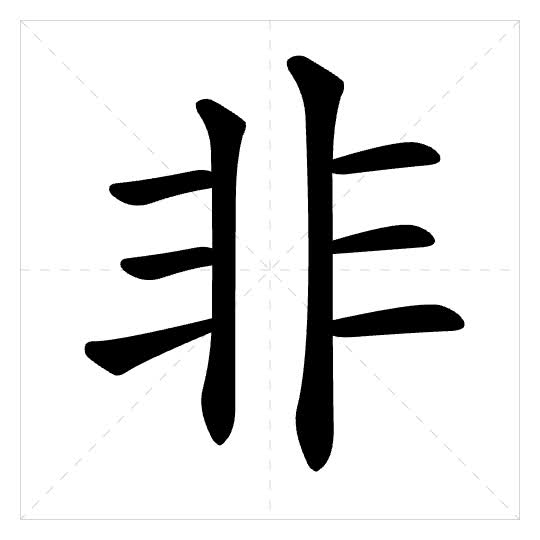
Basic Meaning
adj
Often used in contrast with '是' (shì) to discuss right and wrong.
wrong; incorrect (opposite of 'yes' or 'correct').
错误(跟“是”相对)。
Words:
是非习非成是痛改前非明辨是非大是大非
Synonyms:
Antonyms:
Sentences:
- 要明辨是非,才能做出正确的决定。You must distinguish right from wrong to make the correct decision.
- 这是一个大是大非的问题,不能含糊。This is a matter of major right and wrong; we cannot be ambiguous.
v
Used to describe actions that break rules or norms.
to violate; to be contrary to.
违背;不合于。
Words:
非法非礼非分非道非德
Sentences:
- 随意进入别人的房间是非礼的行为。Entering someone else's room without permission is a discourteous (violating propriety) act.
- 下载盗版软件是非法的。Downloading pirated software is illegal (violates the law).
v
Carries a connotation of disapproval or censure.
to blame; to criticize; to object to.
责备;反对;不以为然。
Words:
未可厚非非难非议无可厚非口是心非
Sentences:
- 大家对他迟到的事颇有非议。People had quite a lot of criticism about him being late.
- 他工作很努力,这点无可厚非。He works very hard; there is nothing to blame about this point.
v
Used for simple negation of a noun or to indicate exclusion (A 非 B = A is not B).
to not be; is not.
不是。
Words:
答非所问并非如此非卖品非亲非故非此即彼
Synonyms:
不无
Sentences:
- 那件展品是非卖品,仅供观赏。That exhibit is a non-sale item; it's for viewing only.
- 我跟你非亲非故,为什么要帮你?I'm neither your relative nor your friend; why should I help you?
adv
A productive prefix for forming compound words.
prefix, used before nouns to indicate 'non-', 'un-', or 'not' (e.g., non-metal).
前缀,用在某些名词性成分前,表示不属于某个范围。
Words:
非金属非晶体非处方
Sentences:
- 木头是非金属材料。Wood is a non-metallic material.
adv
The structure '非...不可/不行' (fēi...bùkě/bùxíng) is very common and emphatic.
adverb, used with '不' (bù) to indicate necessity or inevitability (sometimes '不' is implied).
副词,跟“不”搭用,表示必须,一定(有时后面没有“不”字)。
Words:
非同小可非同寻常
Sentences:
- 这件事非同小可,我们必须认真对待。This matter is no small issue; we must take it seriously.
- 今天的演出非常精彩,观众们非要再听一首歌不可。Today's performance was wonderful, and the audience insisted (非...不可) on hearing one more song.
adv
A standalone, strong modal verb meaning 'must', often used in spoken Chinese. It can sometimes imply stubborn insistence.
(colloquial) must; have to.
〈口〉必须;一定要。
Sentences:
- 我非把这本书看完才睡觉。I simply must finish reading this book before I go to sleep.
- 他非要一个人去旅行,谁也劝不住。He insists on traveling alone, and no one can talk him out of it.
n
An abbreviation, usually part of compound nouns or proper names like 非洲 (Fēizhōu).
short for Africa.
指非洲。
Words:
非盟非洲南非西非北非
Sentences:
- 非盟是非洲重要的区域性组织。The African Union is an important regional organization in Africa.
- 今年暑假他打算去东非看动物大迁徙。This summer vacation, he plans to go to East Africa to see the Great Migration.
Writing & Component
Radical非
Structuresingle
Stroke Count8
Strokes丨一一一丨一一一