
过过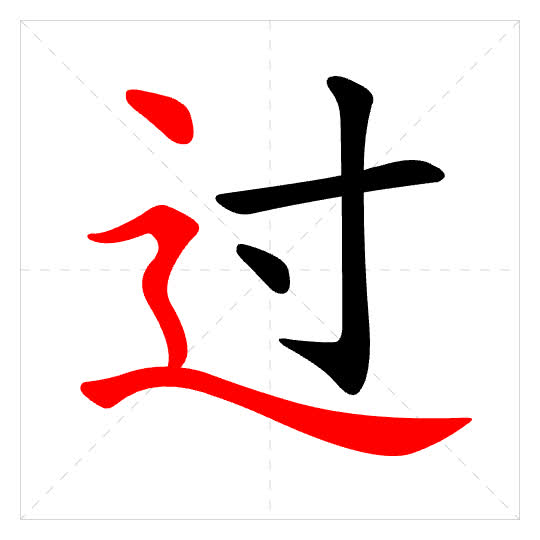
Basic Meaning
v
Often used in compound verbs like 过江, 过户.
to pass through; to go from one place/party to another
从这儿到那儿,从甲方到乙方。
Words:
过户过账过江
Sentences:
- 我们要过马路才能到对面。We need to cross the street to get to the other side.
- 这笔钱需要从公司账户过一下账。This sum of money needs to be transferred from the company account.
v
Commonly used for seasons (过冬), holidays (过节), and processes (过滤).
to pass (through a space or period of time); to spend (time)
经过(某个空间或时间)。
Words:
Sentences:
- 这个春节你打算怎么过?How do you plan to spend this Spring Festival?
v
Often used in the fixed phrase 过目.
to look over; to review mentally
用眼看或用脑子回忆。
Words:
过目
Sentences:
- 这份文件请您过目。Please take a look at this document.
v
to exceed; to surpass (a limit)
超出;超越(某种限度)。
Words:
胆识过人矫枉过正过火过量过期
Sentences:
- 牛奶已经过期了,不能喝了。The milk is already past its expiration date; you can't drink it.
- 这次庆祝活动有点过火了。This celebration event was a bit over-the-top.
adj
Colloquial adjective form of sense 4.
excessive; over-the-top
〈口〉过分;过火。
Words:
过分过火
Sentences:
- 你刚才的话说得太过分了。What you just said was too excessive.
adv
An adverb used before adjectives (e.g., 过大, 过小).
too; excessively (indicates degree)
太;表示程度过分。
Words:
过热用力过猛时间过长过大过小
Synonyms:
Sentences:
- 这个箱子过大,装不进车里。This box is too big; it won't fit in the car.
v
A dialectal euphemism, common in southern dialects (e.g., 过世).
to pass away; to die
〈方〉去世。
Words:
过世过身
Sentences:
- 听说那位老人去年就过世了。I heard that old man passed away last year.
n
A formal or classical noun, often used in fixed phrases (记过, 功过).
fault; mistake (as opposed to 功 'merit')
错误;失误(跟“功”相对)。
Words:
过错记过功过勇于改过改过
Antonyms:
Sentences:
- 他承认了自己的过错,并愿意改过。He admitted his mistake and is willing to reform.
v
Used in contexts of contagion.
to infect; to transmit (a disease)
传染。
Synonyms:
传染
Sentences:
- 感冒会过人,你要注意。A cold is contagious, so you need to be careful.
v
A directional complement, e.g., 走过 'walk past'.
(verb suffix) indicates passing by or through
趋向动词。用在动词后,表示经过。
Sentences:
- 他飞快地从我身边跑过。He ran swiftly past me.
v
A directional complement, e.g., 转过头 'turn one's head'.
(verb suffix) indicates turning a direction
趋向动词。用在动词后,表示掉转方向。
Sentences:
- 她转过头,不看我。She turned her head away and didn't look at me.
v
A potential complement, e.g., 比得过 'can compare favorably with', 比不过 'cannot compare with'.
(verb suffix) indicates surpassing or outdoing; can take 得/不
趋向动词。用在动词后,表示胜过,可以加“得、不”。
Sentences:
- 在跑步速度上,我可比不过他。In terms of running speed, I can't outdo him.
part
Similar to 了(le), but often implies the action is finished and its result is relevant. Common in 吃过饭, 洗过澡.
(aspect particle) placed after a verb to indicate completion
时态助词。用在动词后,表示动作完毕。
Sentences:
- 我洗过澡了,很舒服。I've finished taking a shower; it feels great.
part
The most common usage. It expresses that something happened at least once in the past, e.g., 我去过北京 'I have been to Beijing'.
(aspect particle) placed after a verb to indicate a past experience
时态助词。用在动词后,表示事情曾经发生。
Sentences:
- 我以前去过上海。I have been to Shanghai before.
- 你吃过中国菜吗?Have you ever eaten Chinese food?
part
Indicates a change of state, e.g., 他胖过 'He was fat (in the past, implying he is not now)'.
(aspect particle) placed after an adjective to compare a past state with the present
时态助词。用在形容词后,表示把情况同现在相比。
Sentences:
- 这孩子以前瘦过,现在很健康。This child used to be thin (in the past), but now is very healthy.
v
A directional complement, often implying a mistake or excess, e.g., 坐过站 'ride past one's stop'.
(verb suffix) indicates going beyond a suitable point
趋向动词。用在动词后,表示超过合适的处所。
Sentences:
- 我睡着了,坐过了两站。I fell asleep and rode past two stops.
Writing & Component
Radical辶
Structuresemi_enclosed
Stroke Count6
Strokes一亅丶丶㇋㇏