
是是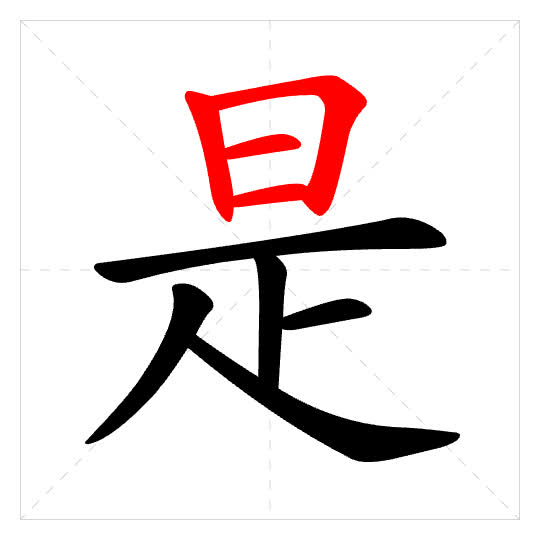
Basic Meaning
adj
Often used in contrast with 非 (wrong).
correct; right
对;正确(跟“非”相对)。
Words:
一无是处自以为是实事求是是非习非成是
Sentences:
- 这个答案是对的。This answer is correct.
- 是非问题需要仔细思考。Right and wrong issues require careful thought.
v
Used in responses to indicate agreement.
to agree; to say yes
答应;同意。
Sentences:
- 是,我知道。Yes, I know.
pron
Literary usage, similar to 这 or 这个.
this; that
〈书〉指示代词。这;这个。
Words:
如是是时是可忍,孰不可忍由是可知是年
Sentences:
- 是时,天气很热。At that time, the weather was very hot.
v
Connects two things to show they are the same or describe properties.
to be (indicating identity or attribute)
联系两种事物,表明两者同一或后者说明前者的种类、属性。
Sentences:
- 他是我的老师。He is my teacher.
v
Shows the subject belongs to the situation described after 是.
to be (indicating belonging to a category)
联系两种事物,表示陈述的对象属于“是”后面所说的情况。
Sentences:
- 这本书是很有趣的。This book is very interesting.
v
Subject is often a location word, followed by the thing that exists.
to be (indicating existence)
表示存在,主语通常是表处所的词语,“是”后面表示存在的事物。
Words:
满身是汗
Sentences:
- 桌子上是一杯水。On the table is a glass of water.
v
Emphasizes the affirmed situation.
to be (used at sentence start for emphasis)
用在句首,强调所肯定的情况。
Sentences:
- 是谁告诉你的?Who told you that?
v
Used before nouns to imply 'all' or 'if it is'.
to be (meaning 'every' or 'if')
用在名词前,有“凡是”“若是”的意思。
Sentences:
- 是人都会犯错。Everyone makes mistakes.
v
Used before nouns to indicate suitability.
to be (meaning 'suitable')
用在名词前,有“适合”的意思。
Sentences:
- 这场雨下的很是时候。The rain came at just the right time.
v
Used in choice questions, yes-no questions, or rhetorical questions.
to be (used in interrogative sentences)
用在选择问句、是非问句或反问句里。
Sentences:
- 你是学生吗?Are you a student?
v
Must be stressed in speech to show strong affirmation.
to be (emphatic, meaning 'indeed' or 'really')
(必须重读)表示坚决肯定,含有“的确、实在”的意思。
Sentences:
- 我确实是这么想的。I really think so.
v
Single use: emphasizes fact or shows concession. Repeated use: indicates authenticity or temporary acceptance.
to be (with various meanings when connecting identical words)
联系两个相同的词语,单用或连用,表示多种附加意义。①单用,强调事实如此。②单用,表示让步,有“虽然”的意思.常和“但是”“可是”“就是”等呼应。③连用,表示“地道”或不能混淆。④联系两个相同的数量结构,表示暂且安于已得到或已实现的。
Sentences:
- 好是好,但是太贵了。It's good, but too expensive.
v
Parts before and after 是 can be swapped without changing meaning; negated only with 不.
to be (indicating equivalence)
联系两种事物,表示等同。“是”前后两部分可以互换而意思不变(只能用“不”否定)。
Sentences:
- 北京是中国的首都。Beijing is the capital of China.
v
Parts cannot be swapped; negated only with 不. Often followed by nominal phrases or 的 structures.
to be (indicating classification)
联系两种事物,表示归类。前后两部分不能互换(只能用“不”否定)。①“是”后为名词性词语。②“是”后为表事物的“的”字结构。
Sentences:
- 苹果是水果。Apples are fruit.
v
Can often be omitted in context.
to be (indicating possession, similar to 有)
联系两种事物,表示领有(“是”类似“有”,可省略)。
Sentences:
- 他是两个孩子的父亲。He is the father of two children.
Writing & Component
Radical日
Structuretop_bottom
Stroke Count9
Strokes丨𠃍一一一丨一丿㇏