
拿拿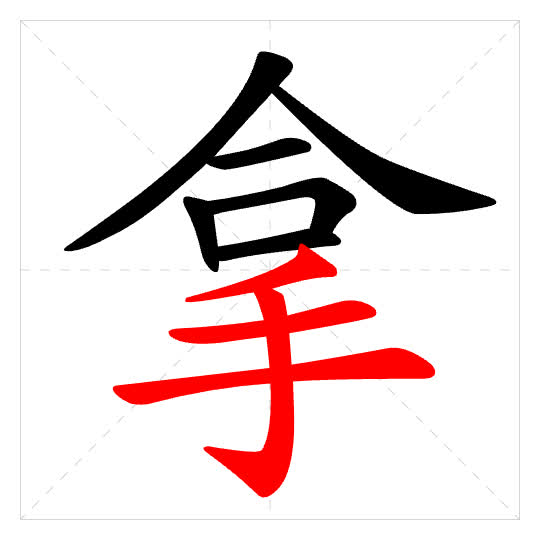
Basic Meaning
v
Often used with aspect markers 了, 着, 过.
to hold (in one's hand); to take; to bring
用手或用别的方式抓住或移动(可带“了、着、过”)。
Words:
拿笔拿纸拿张纸来拿枪拿着
Sentences:
- 你可以帮我拿笔吗?Can you get the pen for me?
- 他拿着一个苹果。He's holding an apple.
- 我去拿张纸来。I'll go get a piece of paper.
v
to capture; to seize; to take by force
用强力取;捉。
Words:
拿获捉拿拿住拿下
Synonyms:
捉
Antonyms:
Sentences:
- 警察终于拿获了那个小偷。The police finally captured that thief.
- 我们的球队拿下了这场比赛。Our team seized victory in this match.
v
Often appears in phrases like 拿主意.
to be in control of; to be sure of; to decide
掌握,把握。
Words:
拿主意拿事拿权拿不准拿定
Sentences:
- 这件事,你得自己拿主意。You have to decide for yourself on this matter.
- 他对这个计划拿不准。He's not sure about this plan.
v
Often carries a slightly negative connotation.
to put on (an act); to affect
装出;做出。
Words:
拿架子拿腔作势
Sentences:
- 别在我面前拿架子。Don't put on airs in front of me.
v
to receive; to obtain; to get
领取;取得。
Words:
拿工资拿金牌拿名次
Synonyms:
Sentences:
- 他每个月15号拿工资。He gets his salary on the 15th of every month.
- 她在比赛中拿了金牌。She got a gold medal in the competition.
prep
Equivalent to 用, introduces a tool or method.
(preposition) using; with
引进所凭借的工具、材料、方法等,意思跟“用”相同。
Words:
拿眼看拿尺量
Synonyms:
Sentences:
- 我拿尺量了桌子的长度。I measured the length of the table with a ruler.
prep
Grammatical structure: 拿 + Object + Verb.
(preposition) used to introduce the object being dealt with
引进所处置或所关涉的对象。
Sentences:
- 我拿他没办法。I can't do anything with him / about him.
- 你拿这件事怎么办?What are you going to do about this matter?
prep
Always used with 来说 or 来讲 to introduce a topic for discussion.
(preposition) as for; concerning; talking about
从某方面提出话题。跟“来说、来讲”搭配使用,引进要说明的事物或情况。
Sentences:
- 拿天气来说,今天真不错。Speaking of the weather, today is really nice.
- 拿学习来讲,努力是最重要的。As for studying, hard work is the most important thing.
Writing & Component
Radical手
Structuretop_bottom
Stroke Count10
Strokes丿㇏一丨𠃍一丿一一亅