
把把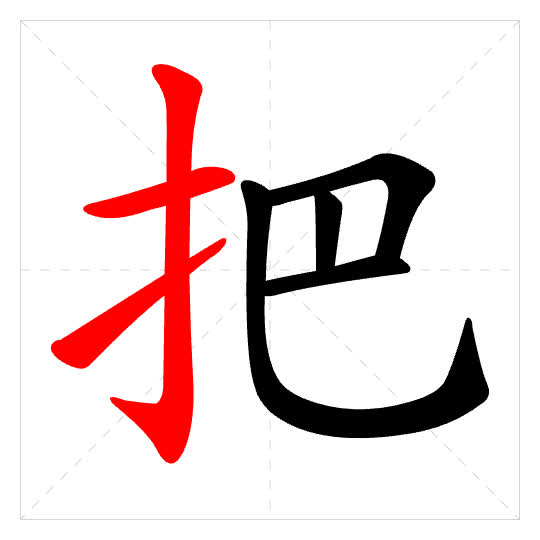
Basic Meaning
v
A common verb, often used in formal or literary contexts like 把握 (grasp/control), 把酒 (hold wine), or in instructions like 手把手 (hands-on).
to hold; to grasp
拿,抓住。
Words:
把舵把握把盏把酒手把手
Sentences:
- 请把好方向盘,注意安全。Please hold the steering wheel steady and pay attention to safety.
- 他激动地一把抓住了我的手。He excitedly grabbed my hand.
v
Specifically for young children/infants. Very colloquial. Often reduplicated as 把把 (relieving oneself).
to hold a baby out to help it relieve itself
从后面用手托起小孩儿两腿,让他大小便。
Words:
把尿把屎尿尿把把
Sentences:
- 宝宝好像要上厕所了,你快去把他把把。The baby seems to need to go to the toilet, quickly go and hold him out to relieve himself.
v
Usually has a negative connotation, implying seizing control unfairly. Often seen in words like 把持 and 把揽.
to monopolize; to dominate (derogatory)
把持(含贬义)。
Words:
把持把揽
Synonyms:
揽
Sentences:
- 他总是想把持公司里所有重要的项目。He always tries to monopolize all the important projects in the company.
v
Often used with places or entrances like doors, passes, checkpoints. 把风 means to keep watch/act as a lookout.
to guard; to keep watch
把守,看守。
Words:
把门把关把守把风把住关口
Synonyms:
守
Sentences:
- 保安正在大楼门口把守。The security guard is guarding the entrance of the building.
- 这次考试很严格,老师亲自把关。This exam is very strict; the teacher is personally checking/supervising.
v
Refers to physically preventing something from splitting open or falling apart.
to bind; to hold together
约束住,使不裂开。
Sentences:
- 箱子快散了,用绳子把它把住。The suitcase is about to fall apart; use a rope to bind it together.
n
Informal, often suffixed with 儿. E.g., 草把儿 (bundle of grass), 秫秸把 (bundle of sorghum stalks).
bundle; bunch (of something tied together)
(~儿)把东西扎在一起的捆子。
Words:
草把手巾把秫秸把草把儿
Sentences:
- 爷爷用草把儿生火做饭。Grandpa uses bundles of grass to start a fire for cooking.
prep
1) Disposal: 把+Object+Verb (处置义). 2) Resultative/Causative: Verb is like 忙坏, 累死, etc. (致使义). 3) Adverse Passive: Object is the agent of an undesirable action (施事不如意). Word order is crucial (S + 把 + O + V + ...).
[Disposal/Resultative/Causative Preposition] marks the object before the verb.
①宾语是后面动词的受事者,整个格式大多有处置的意思。②后面的动词,是“忙、累、急、气”等加上表示结果的补语,整个格式有致使的意思。③宾语是后面动词的施事者,整个格式表示不如意的事情。
Words:
把头一扭把腰一弯
Sentences:
- 请把门关上。Please close the door. (Disposal: 门 is the object of 关)
- 这工作把我累坏了。This job has exhausted me. (Resultative/Causative: 累坏)
part
Used after 百, 千, 万, or measure words like 里, 斤, 个. It implies 'around/roughly' that number. No numeral can precede it (e.g., 百把, not *一百把).
[Approximation Particle] added after certain numbers/measures to indicate 'approximately'.
加在“百、千、万”和“里、丈、顷、斤、个”等量词后头,表示数量近于这个单位数(前头不能再加数词)。
Words:
个把月百把块钱斤把重千把棵树万把条枪
Sentences:
- 我大概等了有个把小时。I waited for roughly an hour or so.
- 这本书不贵,就百把块钱。This book isn't expensive, just around a hundred kuai.
n
Exclusively refers to the bond formed by 拜把子 (to become sworn brothers). Used in terms like 把兄弟 and 把兄.
relationship of being sworn brothers (via 拜把子)
指拜把子(结为异姓兄弟)的关系。
Words:
把兄把嫂把兄弟拜把子拜把
Sentences:
- 他们是拜把子兄弟,感情特别好。They are sworn brothers and have a particularly good bond.
v
Similar to sense 1 but more focused on control or skilled operation, as in 把舵 (to steer/hold the helm) or 把犁 (to hold the plow). Can be neutral or positive.
to control; to master; to hold (a tool/position)
控制,掌握。
Words:
把舵把权把犁把关
Sentences:
- 船长在暴风雨中稳稳地把着舵。The captain steadily held the helm during the storm.
- 她是这个项目的负责人,要把好质量关。She is the person in charge of this project and must firmly control the quality checkpoint.
q
A very versatile measure word. Pay attention to the specific category (concrete tool, abstract concept, action) when using it.
[Measure Word] 1. for tools with handles. 2. a handful. 3. for abstract things (age, effort). 4. for hand actions. 5. for instances of actions.
①用于有把手或能用手抓起的器具。②(~儿)用于一手抓起的数量。③用于某些抽象的事物。④用于手的动作。⑤用于动作、事情的次数。
Words:
一把刀一把米一把年纪拉他一把过把瘾
Sentences:
- 我需要买一把新的剪刀。I need to buy a new pair of scissors. (for tools with handles)
- 她抓了一把糖分给小朋友们。She grabbed a handful of candy and distributed it to the children. (a handful)
- 他可是有一把年纪的人了,经验丰富。He is a person of considerable age, with rich experience. (abstract: age)
Writing & Component
Radical扌
Structureleft_right
Stroke Count7
Strokes一亅㇀𠃍丨一乚
Related Articles
One unified blog surface for comparison and usage reading, grouped by the same headword.