
住住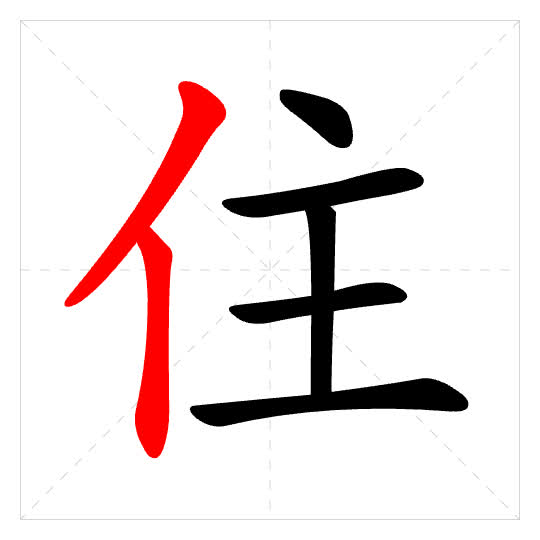
Basic Meaning
v
When asking about where someone lives, a common question is '你住在哪里?'. It is also the verb used for staying in a hotel or a friend's house for a short time.
to live (somewhere permanently); to stay; to reside; to lodge
长期居留或暂时留宿。
Words:
住宿住址住宅居住住所
Synonyms:
宿居
Sentences:
- 我在上海住了五年了I have lived in Shanghai for five years.
- 你今晚想住在朋友家吗Do you want to stay at a friend's house tonight?
- 我们的住址是平安路123号Our residential address is 123 Ping'an Road.
v
Used with specific body parts or actions, especially in commands like 住手 (stop your hand) or 住口 (stop your mouth/shut up). These are imperative and direct.
to stop; to cease; to halt
停住;止住。
Words:
住口住手住嘴停住止住
Sentences:
- 老师让孩子们住口,保持安静The teacher told the children to shut up and be quiet.
- 车开到路口,突然停住了The car drove to the intersection and suddenly stopped.
v
This is one of the most common and important grammatical uses of 住. It is attached to verbs to add meanings like 'securely', 'successfully', or 'to a stop'. For example, '记住' means 'to remember (keep firmly in mind)', '站住' means 'to stand still', and '禁不住' means 'cannot withstand'.
Used as a verb complement. 1) To indicate stability or being firmly attached. 2) To indicate a pause or becoming still. 3) To indicate sufficiency of strength/capacity (used with '得' or '不').
用作动词的补语。①表示稳当或牢固。②表示停顿或静止。③表示力量够得上(跟“得”或“不”连用)。
Words:
Sentences:
- 这个结打得很结实,捆住了This knot is tied very firmly; it's fastened securely.
- 请记住我的电话号码Please remember my phone number.
- 这张旧椅子禁不住你这么重的体重This old chair cannot withstand your heavy weight.
Writing & Component
Radical亻
Structureleft_right
Stroke Count7
Strokes丿丨丶一一丨一