
果果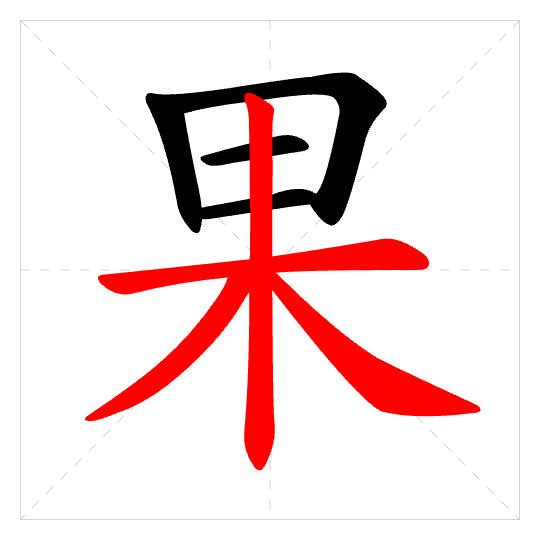
Basic Meaning
n
As a noun, it often appears in compound words.
fruit; the seed-containing part of a plant that develops after flowering.
果实,植物开花后含有种子的部分。
Words:
Sentences:
- 他买了一篮新鲜的水果。He bought a basket of fresh fruit.
- 春天开花,秋天就会结果。If it blossoms in spring, it will bear fruit in autumn.
n
Commonly found in words like 结果 and 后果. Contrasts with 因.
outcome; result (as opposed to 'cause').
事情的结局;结果(跟“因”相对)。
Words:
Antonyms:
Sentences:
- 多年的努力终于有了好结果。Years of hard work finally yielded a good outcome.
- 你要为自己的决定承担后果。You must bear the consequences of your own decision.
adj
Primarily used in formal or written contexts.
resolute; decisive; not hesitant.
不犹豫;坚决。
Words:
果敢果断果决果直果劲
Sentences:
- 他是一个非常果敢的领导者。He is a very resolute and courageous leader.
- 面对危机,她的处理方式很果断。Facing the crisis, her way of handling it was very decisive.
adv
Often used adverbially to confirm an expectation, similar to 'as expected'.
indeed; really; sure enough.
果然,确实,真的。
Words:
果真果不其然果为所害果然果是
Sentences:
- 他说会下雨,果不其然,真的下了。He said it would rain, and sure enough, it did.
- 他昨天说自己生病了,果真没来上班。He said he was sick yesterday, and indeed, he didn't come to work.
v
This usage is mostly classical and appears in fixed phrases.
to fill up; to be satiated.
饱;充实。
Words:
食不果腹果腹
Sentences:
- 在那个年代,很多人食不果腹。In that era, many people did not have enough to eat.
conj
A classical conjunction often introducing a hypothetical condition followed by a conclusion.
if indeed; supposing that.
果然。
Words:
果能如此
Sentences:
- 果能如此,大家都会很高兴。If this can indeed be the case, everyone will be very happy.
Writing & Component
Radical木
Structuresingle
Stroke Count8
Strokes丨𠃍一一一丨丿㇏