
胜胜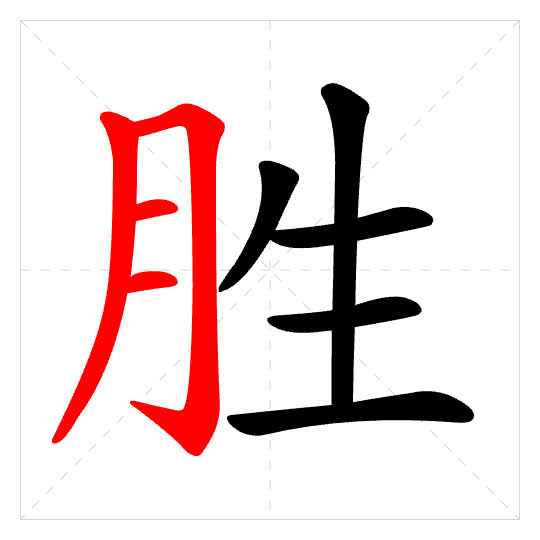
Basic Meaning
v
Common in sports and competition contexts.
to defeat (an opponent or enemy); to win.
打败对手或敌人。
Words:
取胜得胜出奇制胜获胜胜利
Synonyms:
Sentences:
- 我们队在昨天的比赛中获胜了。Our team won in yesterday's competition.
- 只要团队合作,我们就能取胜。As long as we cooperate as a team, we can achieve victory.
v
Often followed by prepositions like 于 or 过 to make comparisons.
to be superior to; to surpass.
比另一个优越(后面常带“于、过”等)。
Words:
略胜一筹今胜于昔
Sentences:
- 他的新计划的确略胜一筹。His new plan is indeed slightly better.
- 很多游客觉得这里的风景胜过其他地方。Many tourists think the scenery here surpasses that of other places.
adj
Primarily used to describe places and experiences. Often appears in fixed terms like 胜地 (scenic spot).
fine; beautiful; superb (scenery, views, etc.).
优美的(景物、境界等)。
Words:
胜景胜会胜地引人入胜胜境
Sentences:
- 桂林是一个著名的旅游胜地。Guilin is a famous scenic tourist destination.
- 山顶的景色真是太美了,堪称胜景。The view from the mountaintop is truly beautiful; it can be called a superb scene.
n
A 'fine scene' or 'beautiful place'. Often used as a noun in words like 名胜.
wonder; fine scenery; beautiful place.
优美的景物或境界。
Words:
名胜引人入胜名胜古迹
Sentences:
- 这座城市有很多名胜古迹。This city has many famous scenic and historical sites.
- 这篇文章把美丽的风景描写得引人入胜。This article describes the beautiful scenery in an absorbing/fascinating way.
v
Describes capability, often used in negative or hypothetical contexts. 不 often precedes it to mean 'cannot bear'.
can bear; can endure; to be equal to (a task).
能够承担或承受。
Words:
不胜其烦不胜喜不自胜不胜酒力胜任
Sentences:
- 他的工作能力很强,完全能胜任这个职位。His work ability is very strong; he is completely competent for this position.
- 他喝了三杯啤酒,已经不胜酒力了。He has drunk three glasses of beer and can't hold his liquor anymore.
adv
A literary/formal adverb meaning 'completely' or 'to the utmost'. Often used in four-character idioms.
exhaustively; all; to the end.
尽。
Words:
不可胜数不胜枚举防不胜防美不胜收数不胜数
Sentences:
- 春节的夜晚,空中绽放的烟花美不胜收。On the night of the Spring Festival, the fireworks blossoming in the sky are endlessly beautiful (too many beautiful scenes to take in).
- 这样的事情每天都会发生,简直数不胜数。Things like this happen every day; they are too many to count.
Writing & Component
Radical月
Structureleft_right
Stroke Count9
Strokes丿𠃌一一丿一一丨一