
而而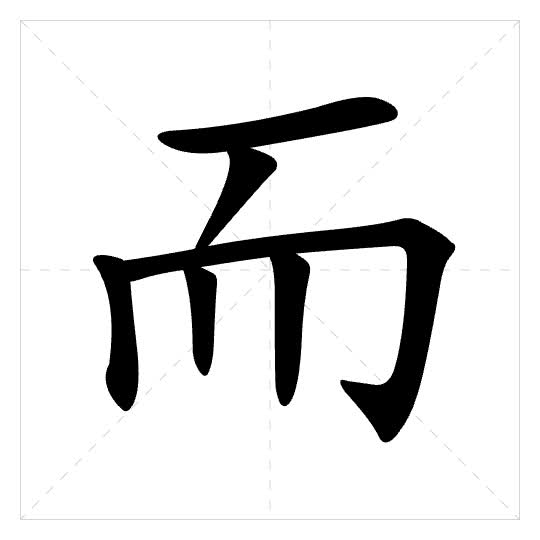
Basic Meaning
conj
It's a multi-functional literary particle common in set phrases and formal writing, less common in casual speech on its own. The specific meaning (and, but, yet, so) depends entirely on the context of the connected parts. It is not preceded by a comma in Chinese.
A conjunction that connects verbs, adjectives, phrases, or clauses. It can indicate continuation (e.g., 'and'), contrast (e.g., 'but, yet'), or supplement (e.g., 'but not').
连接动词、形容词或词组、分句等。①连接语意相承的成分。②连接肯定和否定互相补充的成分。③连接语意相反的成分,表示转折。④连接事理上前后相因的成分。
Words:
少而精取而代之一望而知华而不实青出于蓝而胜于蓝侃侃而谈飘然而去挺身而出
Sentences:
- 这家餐厅的菜少而精,味道很好。This restaurant's dishes are few but excellent, and they taste great.
- 手机需要好看而实用。A mobile phone needs to be good-looking and practical.
- 他想帮忙,而不知道怎么做。He wants to help, but doesn't know how.
conj
Used to connect two points, states, or directions, often in the structure "由/从 A 而 B". Functions similarly to "to" in "from A to B".
From ... to ...; Indicating a range, transition, or direction.
(从)……到……。
Words:
自上而下由小而大由南而北由高而低由长而幼
Synonyms:
Sentences:
- 公司正在自上而下地推行新的规定。The company is implementing the new regulations from the top down.
- 温度由低而高,慢慢上升。The temperature rose slowly from low to high.
conj
A key grammatical use of 而. The structure is typically: [Adverbial Phrase] + 而 + [Verb]. The phrase describes the manner, condition, or reason for the action (the verb).
Connects an adverbial modifier (often a phrase) to the main verb.
把状语连接到动词上。
Words:
匆匆而来顺流而下因人而异挺身而出因公而死
Sentences:
- 他拿起电话侃侃而谈。He picked up the phone and spoke confidently and at length.
- 价格会因人而异。The price varies from person to person.
conj
This is a classical Chinese usage still found in some set phrases or formal, literary contexts. It is not commonly used to form conditional sentences in modern colloquial speech (where 如果 is used).
When placed between the subject and predicate, it gives a conditional meaning similar to 'if'.
插在主语谓语之间,有“如果”的意思。
Sentences:
- 你辛苦学习而不讲究方法,可能不会取得好成效。You may not achieve good results if you study hard but don't pay attention to the right methods.
Writing & Component
Radical而
Structuresingle
Stroke Count6
Strokes一丿丨𠃌丨丨