
末末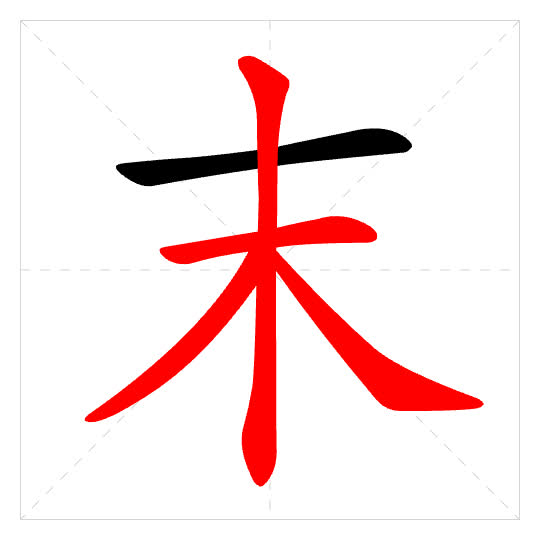
Basic Meaning
n
Often used with '末端', '末梢' to describe the tip or tail of something.
tip; end
物的前端或末尾。
Words:
末梢细枝末节秋毫之末末端
Synonyms:
尾
Sentences:
- 这根树枝的末梢有点干枯了。The tip of this branch is a bit withered.
- 请抓住绳子的末端。Please grab the end of the rope.
n
Used to contrast with '本', the fundamental or primary part.
non-essential part; minor detail
不是根本的、主要的事物(跟“本”相对)。
Words:
本末倒置舍本逐末舍本求末
Synonyms:
Sentences:
- 写论文时,不要舍本逐末,只关注格式。When writing your thesis, don't focus on minor details like formatting and neglect the core content.
- 这些都是细枝末节的问题,不影响大局。These are all trivial issues that don't affect the overall situation.
n
Often used for periods (week/month/year end) or in compound words describing finality, contrasting with '始'.
end; last
最后,终了,跟“始”相对。
Words:
Synonyms:
尾
Sentences:
- 周末我们去看电影吧。Let's go watch a movie at the weekend.
- 月末我得把这份报告写完。I have to finish writing this report by the end of the month.
n
Often suffixed with '-末儿' or '-末'. Can be the result of grinding, sawing, or wear.
powder; dust; fine particles
(~儿)碎屑;粉末。
Words:
锯末药末儿肉沫儿粉笔末粉末
Synonyms:
屑
Sentences:
- 桌子上有一些粉笔末。There's some chalk dust on the table.
- 地上全是锯末,需要打扫一下。The floor is covered with sawdust and needs cleaning.
Writing & Component
Radical木
Structuresingle
Stroke Count5
Strokes一一丨丿㇏