
姨姨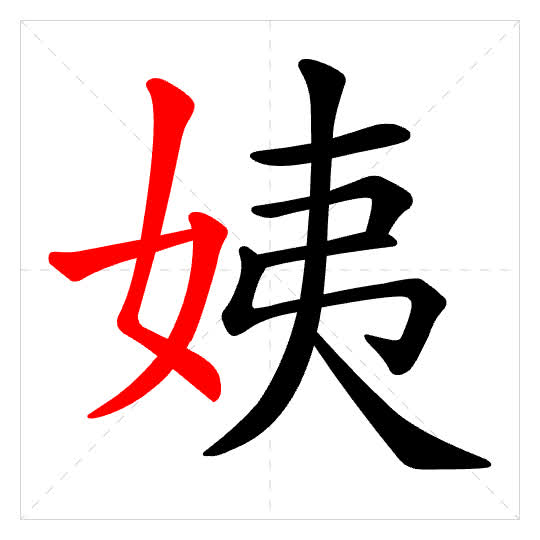
Basic Meaning
n
Often used in family contexts; can be combined with other terms like 姨妈 (mother's sister) or 姨父 (aunt's husband).
aunt (mother's sister); also used as a respectful term for women of the mother's generation.
姨母,也用来尊称母亲一辈的女性。
Words:
姨妈姨父表姨赵姨小姨
Sentences:
- 我姨妈明天要来我家做客。My aunt (mother's sister) is coming to visit my house tomorrow.
- 赵姨是我妈妈的好朋友。Aunt Zhao is my mother's good friend.
n
Common in informal speech; terms like 小姨子 (younger sister-in-law) or 大姨子 (elder sister-in-law) are specific.
sister-in-law (wife's sister).
妻子的姐妹。
Words:
小姨子大姨子大姨小姨三姨
Sentences:
- 我小姨子最近刚大学毕业。My younger sister-in-law (wife's sister) just graduated from university recently.
- 大姨子帮我照顾孩子。My elder sister-in-law (wife's sister) helps me take care of the children.
n
A polite and common form of address in social settings, e.g., 阿姨 for strangers or acquaintances.
auntie (used to address non-relatives of similar age and status as one's mother).
称呼跟母亲辈分相同、年纪差不多的无亲属关系的女性。
Words:
Sentences:
- 阿姨,请问超市怎么走?Auntie, could you tell me how to get to the supermarket?
- 张姨是我们邻居,人很热情。Auntie Zhang is our neighbor, and she is very warm-hearted.
n
Archaic usage; modern contexts rarely use this, but it appears in historical or literary settings.
concubine (historical term for a secondary wife or mistress).
过去对妾的称呼。
Words:
姨奶奶姨娘姨太太小姨娘
Sentences:
- 在古代,姨太太的地位比较低。In ancient times, the status of a concubine was relatively low.
- 这个故事里有个角色叫小姨娘。In this story, there is a character called Little Concubine.
Writing & Component
Radical女
Structureleft_right
Stroke Count9
Strokes𡿨丿一一𠃍一㇉丿㇏