
套套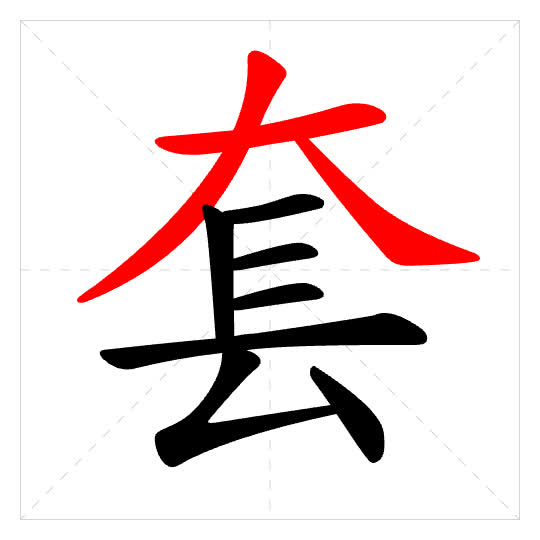
Basic Meaning
n
Often appears as a suffix in compound nouns like 外套 (coat) or 手套 (glove).
a cover; a case; (an item that goes over the outside of something)
(~子、~儿)罩在外面的东西。
Words:
外套手套书套钢笔套褥套
Sentences:
- 外面很冷,出门记得穿上外套。It's very cold outside, remember to wear a coat when you go out.
- 我的钢笔套丢了,现在笔尖都脏了。I lost my pen cap, and now the nib is all dirty.
v
Typically used when referring to putting a protective or decorative outer layer onto an object or body part, like sleeves or pants.
to cover (the outside of something); to put on (an outer layer)
加罩。
Words:
套袖套裤
Sentences:
- 他在工装裤外面又套了一条耐磨的套裤。He put a pair of wear-resistant chaps over his work pants.
n
Refers specifically to the insulated padding, not the whole item. It's what goes *inside* a 被套 (duvet cover).
quilt batting; cotton wadding (inside clothing or bedding)
(~子、~儿)装在衣物里的棉絮。
Words:
被套套袄套子
Sentences:
- 冬天盖的厚被子需要用新棉花做被套。The heavy quilt for winter needs a new cotton batting.
n
Often used in compound nouns for coordinated items, like 套装 (suit, set of clothes) or 套餐 (set meal).
a set; a suite; a collection of things that form a complete whole
事物配合成的整体。
Words:
套装成套乱套套餐配套
Sentences:
- 我买了这套餐具,包括盘子、碗和杯子。I bought this tableware set, which includes plates, bowls, and cups.
- 这个餐厅的套餐很划算,有主食、汤和饮料。The set meal at this restaurant is a great deal, it includes a main course, soup, and a drink.
v
Often has a negative connotation of being uncreative or inappropriate, as in 生搬硬套.
to apply mechanically; to copy rigidly; to use (a formula, model, etc.) without adaptation
模拟,照做。
Words:
套用生搬硬套套公式
Synonyms:
仿照
Sentences:
- 写作文可以学习好的结构,但不能生搬硬套别人的观点。When writing an essay, you can learn from good structures, but you shouldn't copy other people's points of view mechanically.
- 解这个数学题需要动脑子,不能直接套公式。Solving this math problem requires thinking, you can't just apply the formula mindlessly.
v
Describes things fitting together in sequence or spatially, like in agriculture (套种 - intercropping) or printing (套色 - multicolor printing).
to interlock; to overlap; to be nested within
互相衔接或重叠。
Words:
套种套色套间亲上套亲套印
Sentences:
- 这块地里套种了玉米和豆子。Corn and beans are intercropped in this field.
n
A specific, somewhat dated term related to animal-powered farming/transport.
traces; harness (the ropes for hitching a draught animal to a cart)
拴牲口的两根皮绳或麻绳,一端拴在牲口脖子夹板或轭上,另一端拴在车上。
Words:
牲口套大车套车套套绳拉套
Sentences:
- 爷爷在给马准备新的车套。Grandpa is preparing a new harness for the horse.
q
Used for homogeneous, tangible items sold or used together, like 一套餐具 (a set of tableware).
classifier for (physical) sets of things
量词,用于合成一组的同类事物。
Words:
一套
Sentences:
- 她收藏了一套漂亮的纪念邮票。She collected a beautiful set of commemorative stamps.
v
The action verb related to sense 9.
to hitch up (an animal); to harness
用套拴系。
Words:
套车套马
Sentences:
- 天快黑了,咱们快把车套好吧。It's getting dark, let's hurry up and hitch up the cart.
q
Used for intangible, conceptual, or procedural sets, like 一套办法 (a set of methods). Contrast with sense 10, which is for physical objects.
classifier for (abstract) systems, methods, skills, routines, words, etc.
用于机构、制度、本领、办法、言语等。
Words:
两套班子一套章程
Sentences:
- 他给团队成员讲了一套新的工作方案。He explained a new set of work plans to the team members.
- 想要学好中文,你需要掌握一套有效的学习方法。To learn Chinese well, you need to master an effective set of learning methods.
n
Refers to unoriginal, customary ways of doing or saying things, often with a slightly negative connotation. 俗套 and 套话 are common collocations.
conventional pattern; formula; set phrases; routine
(~儿)套子。
Words:
客套俗套套话套数老一套
Sentences:
- 别总说那些客套话了,我们都是老朋友。Stop saying all those polite formalities, we are old friends.
v
Implies a cunning or indirect method of questioning.
to trick (someone) into revealing the truth; to fish for information
引人说出实情。
Sentences:
- 警察用了好几个小时,终于从他嘴里套出了实情。It took the police several hours to finally fish the truth out of him.
v
Often used in the phrase 套近乎. Can imply insincerity.
to try to get close to; to cozy up to
拉拢;笼络。
Words:
套近乎套交情
Sentences:
- 他总想跟我套近乎,但我不太喜欢他。He always tries to cozy up to me, but I don't really like him.
n
Very close to sense 14, emphasizing the verbal or procedural aspect of conventionality. Often negative.
conventional, formulaic talk; clichéd method
现成的应酬话;陈陈相因的办法。
Sentences:
- 这位领导的发言全是套话,没有什么实际内容。This leader's speech is full of empty clichés, with no real substance.
Writing & Component
Radical大
Structuretop_bottom
Stroke Count10
Strokes一丿㇏一丨一一一𠃋丶