
些些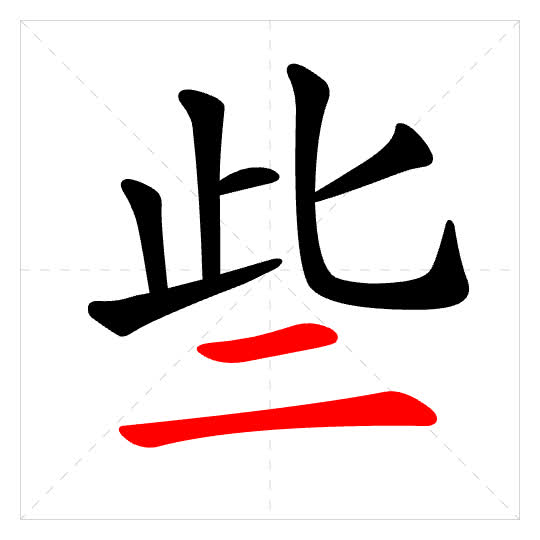
Basic Meaning
q
Often used with adjectives or verbs to soften the tone or indicate a small degree. Compare with 一点儿 (yidianr), which is more common in spoken Chinese for similar meaning.
Added after verbs or adjectives, indicating a slight or minor degree (somewhat, a little).
放在动词、形容词后,有稍稍、略微的意思。
Words:
多些少些注意些小心些小些
Sentences:
- 请走慢些。Please walk a bit slower.
- 今天的作业简单些了。Today's homework is a bit simpler.
- 你说话小声些。Please speak a little quieter.
q
Commonly used as 一些 (yixie) or in words like 这些, 那些. It is a general measure word for unspecified quantities.
Indicates an indefinite amount (some, a few).
表示不定的数量;一些。
Sentences:
- 我买了一些水果。I bought some fruits.
- 这些书是你的吗?Are these books yours?
- 前些日子我见过他。I saw him some days ago.
q
Note that 些 usually indicates a small amount, but when combined with 好 or 这么, it instead emphasizes a large quantity. For example, 好些 means 'quite a lot'.
Used with '好' or '这么' to indicate a large amount (so many, quite a lot).
跟“好”“这么”连用,表示很多。
Words:
这么些好些
Sentences:
- 他买了好些新衣服。He bought quite a lot of new clothes.
- 这么些作业,我今天做不完。There's so much homework, I can't finish it today.
- 公园里有好些人在跳舞。There are quite a lot of people dancing in the park.
Writing & Component
Radical二
Structuretop_bottom
Stroke Count8
Strokes丨一丨㇀丿乚一一