
准准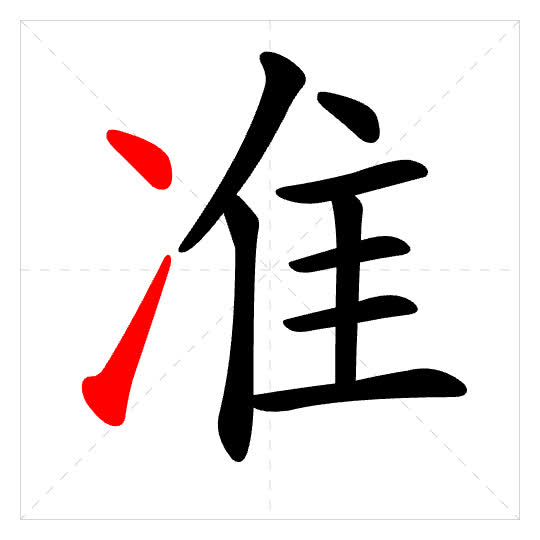
Basic Meaning
n
Often seen in formal or technical contexts. Anchor words like 准则 are common nouns.
standard; criterion; rule; something that can be used as a basis
标准,法则,可以作为依据的。
Words:
基准水准准绳准则标准
Sentences:
- 这家公司有严格的道德准则。This company has strict ethical standards.
- 质量必须达到国际标准。The quality must meet international standards.
v
Commonly used in spoken Chinese for giving or denying permission.
to permit; to allow
允许,许可。
Words:
批准不准准许准予允准
Synonyms:
允许
Sentences:
- 老师不准我们在课堂上玩手机。The teacher does not allow us to play with our phones in class.
- 经理已经批准了我们的假期申请。The manager has already approved our leave application.
adj
Often used in compound words to describe precision or exactness.
accurate; correct
准确;正确。
Words:
Synonyms:
Sentences:
- 请把时间说准确一点。Please state the time more accurately.
- 他投篮非常准。He is very accurate at shooting baskets.
adv
Used before verbs (or in colloquial contractions like 准行) to express strong certainty, often in spoken promises or predictions.
definitely; certainly
一定。
Words:
准行准赢准去准成
Sentences:
- 你别担心,我明天准到。Don't worry, I will definitely be there tomorrow.
- 这场比赛咱们准赢。We are definitely going to win this match.
This is a functional prefix. When explaining, it's usually part of a fixed term like 准将.
[prefix] quasi-; para-; semi-; indicating something that approximates or is analogous to a standard type
﹝前缀﹞加在名词前面,构成名词,表示虽不够标准,但仍可作为某种事物对待。
Words:
准尉准宾语准平原准金属准将
Sentences:
- 他是一名准将。He is a brigadier general. (A 'quasi-' or acting general officer rank).
- 在学习语法时,我们会接触到准宾语这个概念。When studying grammar, we will encounter the concept of 'quasi-object'.
n
Used in specific patterns like 有准儿 (to be sure) or 没准儿 (unreliable/uncertain).
definite assurance; certainty (often used after 'you3' or 'mei2 you3')
确定的把握(多用在”有“或”没有“后)。
Sentences:
- 他这个人做事很有准。He is a person who is very sure and reliable when doing things.
Writing & Component
Radical冫
Structureleft_right
Stroke Count10
Strokes丶㇀丿丨丶一一一丨一