
从从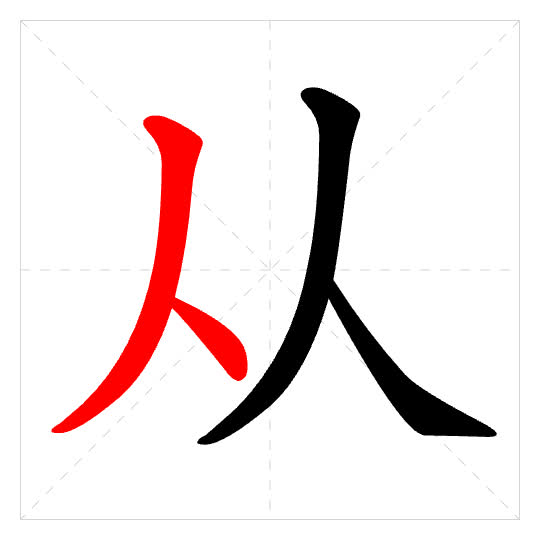
Basic Meaning
v
Often used in formal or respectful contexts, e.g., 听从长辈 (obey elders).
to obey; to comply with
听从;依顺。
Words:
顺从服从听从
Sentences:
- 你应该听从老师的建议。You should obey the teacher's advice.
- 他顺从父母的安排。He complies with his parents' arrangements.
v
Commonly used in compound words like 从事 (engage in a profession).
to participate in; to engage in
参加;参与;从事。
Words:
从事从军从政
Sentences:
- 她从事教育工作很多年了。She has been engaged in education work for many years.
- 他从军后变得很坚强。He became very resilient after joining the army.
v
Often used in phrases like 从简 (adopt simplicity) or 从严 (adopt strictness).
to adopt (a principle or method)
采取(某种原则或办法)。
Words:
从严从优从简
Sentences:
- 这次活动从简办理。This event is handled with simplicity.
- 公司决定从优处理员工福利。The company decided to adopt a preferential approach to employee benefits.
prep
As a preposition, it can indicate origin (e.g., 从北京来), passage (e.g., 从门口过), or basis (e.g., 从实际出发).
from; starting at; via; based on
①起于,“从……”表示“拿……做起点”。②表示经过,用在表示处所的词语前面。③表示根据。
Sentences:
- 我从北京坐火车去上海。I take the train from Beijing to Shanghai.
- 他从门口走过。He walked past the door.
- 从实际情况出发,我们做了这个决定。Based on the actual situation, we made this decision.
adj
Used to describe something that is not primary, e.g., 从犯 (accomplice).
subordinate; secondary
从属的;主要的
Words:
主从从犯从属
Antonyms:
Sentences:
- 在这个案件中,他是从犯。In this case, he is an accomplice.
n
Refers to people who accompany or serve, often in historical or formal settings.
follower; attendant
跟随的人。
Words:
随从侍从仆从
Sentences:
- 国王有很多随从。The king has many attendants.
- 古代官员出行时带着侍从。Ancient officials brought servants when traveling.
Writing & Component
Radical人
Structureleft_right
Stroke Count4
Strokes丿㇏丿㇏