
足足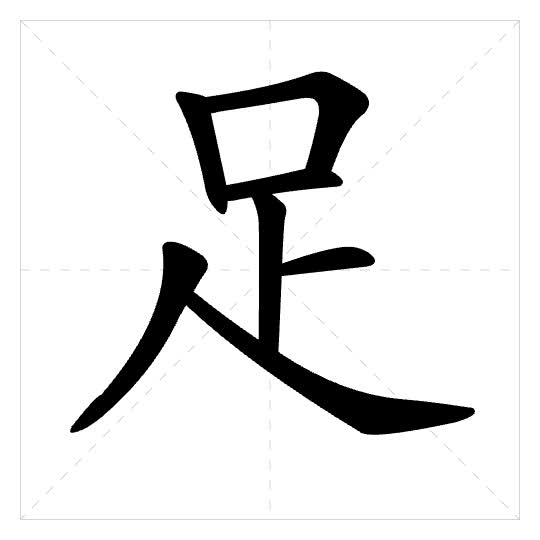
Basic Meaning
n
In modern Chinese, 足 usually means 'foot'. 腿 (tuǐ) is more common for 'leg'. The character often appears in idioms like 手舞足蹈.
foot; leg.
脚;腿。
Words:
足迹手舞足蹈画蛇添足削足适履足不出户
Sentences:
- 沙滩上留下了他的足迹。His footprints were left on the beach.
- 我冬天喜欢穿厚厚的棉袜保护双足。In winter, I like to wear thick cotton socks to protect my feet.
n
This is a more specialized or classical sense, often used in literary or historical contexts. In modern contexts, specific terms like 桌子腿 (table leg) are more common.
the support or leg of an object.
器物下部的支撑部分。
Words:
鼎足三足鼎立鼎足而三
Sentences:
- 这个青铜鼎是三足的。This bronze tripod has three legs.
n
This sense is an abbreviation for 足球 (zúqiú). It's frequently used in compound nouns.
football (soccer) (as a sport).
指足球运动。
Words:
足坛女足男足
Sentences:
- 中国女足赢得了亚洲杯冠军。The Chinese Women's National Football Team won the Asian Cup.
- 他很喜欢看足坛的新闻。He really enjoys reading news about the football world.
adv
Often used in negative expressions (e.g., 不足为奇 'not worth being surprised about'). The affirmative use is less common in modern spoken language.
sufficiently; enough (to do something); worth.
足以;值得(多用于否定式)。
Words:
不足为奇何足挂齿无足轻重微不足道不足为凭
Sentences:
- 这点小事,不足挂齿。Such a small matter is not worth mentioning.
- 他的解释不足以令人信服。His explanation is not sufficient to convince people.
adj
Often used to describe abundance or adequacy. Can overlap with the 'sufficient' meaning of sense 5.
plentiful; sufficient; complete.
充实;完备。
Words:
丰衣足食分类充足足智多谋
Sentences:
- 我们的时间很充足,可以慢慢来。We have plenty of time, we can take it slow.
- 要解决这个难题,需要足智多谋的人才。To solve this difficult problem, we need resourceful and intelligent people.
adj
This sense is typically about mental or emotional satisfaction.
satisfied; content.
满足。
Words:
心满意足知足
Sentences:
- 他对现在的生活很知足。He is very content with his current life.
- 吃完妈妈做的饭,我感到心满意足。After eating the meal my mom cooked, I felt perfectly satisfied.
Writing & Component
Radical足
Structuretop_bottom
Stroke Count7
Strokes丨𠃍一丨一丿㇏