
演演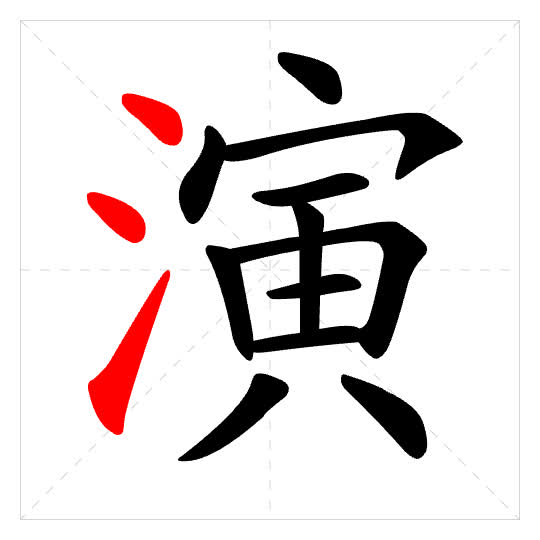
Basic Meaning
v
Often used in formal or academic contexts to describe gradual changes over time, such as in history, biology, or society.
to evolve; to change
演变;变化。
Words:
演进演化演变愈演愈烈蜕演
Sentences:
- 这个物种经过数百万年的演变,适应了新的环境。This species has evolved over millions of years to adapt to the new environment.
- 社会制度在不断演进中变得更加完善。Social systems are becoming more perfect through continuous evolution.
v
Commonly used for artistic or entertainment performances, like singing, playing music, or acting in a play.
to perform; to act
把技艺当众表现出来。
Words:
Sentences:
- 他今晚要在音乐会上演奏钢琴。He will perform on the piano at the concert tonight.
- 她在电影中扮演了一个勇敢的角色。She played a brave role in the movie.
v
Typically refers to rehearsing, training, or performing mathematical calculations in a structured way.
to practice; to drill; to calculate
依照程式(练习或计算)。
Words:
操演演习演算演练演兵场
Sentences:
- 士兵们在操场上进行军事演习。The soldiers are conducting military drills on the training ground.
- 学生们在课堂上练习演算数学题。The students practice calculating math problems in class.
v
Used in contexts like logic, reasoning, or public speaking to extend or explain ideas based on principles.
to deduce; to elaborate; to expound
根据一种事理推广、发挥。
Words:
推演演义演绎演说
Sentences:
- 他根据历史事件推演出了一个新的理论。He deduced a new theory based on historical events.
- 老师在课堂上演绎了这个复杂的科学概念。The teacher elaborated on this complex scientific concept in class.
Writing & Component
Radical氵
Structureleft_right
Stroke Count14
Strokes丶丶㇀丶丶㇇一丨𠃍一丨一丿丶