
某某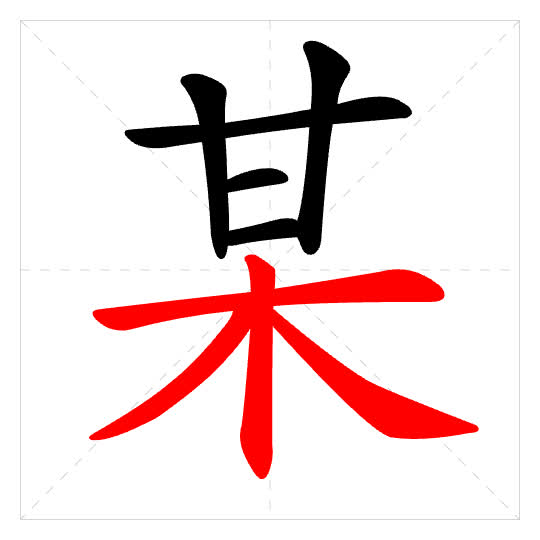
Basic Meaning
pron
This sense is the most general and commonly used form of 某, often found in expressions like 某人, 某地.
A pronoun used to substitute for a person, place, thing, or event that is not explicitly named.
代替不明确指出的人、地、事、物等。
Words:
某地某人某国某日张某
Sentences:
- 我们计划去某地旅游。We plan to travel to some place.
- 某日,我在街上遇到了某人。One day, I met someone on the street.
pron
Often used in formal or systematic contexts, such as lists or surveys.
Used before '甲(乙,丙…)' or numerals (limited to '一', '几') plus a measure word to refer to uncertain people or things.
用在“甲(乙、丙……)”或数词(限于“一、几”)、量词前,指代不确定的人或事物。
Words:
某人某地某年某月某种线索
Sentences:
- 调查显示,某几类产品的销量在增长。The survey shows that sales of several types of products are growing.
- 我们需要找到某种线索。We need to find some kind of clue.
pron
Typically used in legal, news, or official contexts, as in 王某 (Mr. Wang). The second character is often 某 or other characters, e.g., 张某某.
Used after a surname to refer to a specific person whose name is not to be mentioned or is unknown.
用在姓氏后,指别人(此人是确定的,只是不便提名或不知其名)。
Words:
王某张某某
Sentences:
- 报道中提到了一位王某。The report mentioned a person named Mr. Wang.
- 据警方透露,嫌疑人张某某已被拘留。According to police, the suspect Zhang (a certain person) has been detained.
pron
This usage is formal and somewhat archaic, appearing in historical contexts or formal introductions. Modern self-reference uses 我 or one's full name.
Used to refer to oneself or one's own name.
用来代替自己或自己的名字,如“某,张飞是也。”又如姓张的自称“张某”或“张某人”。
Sentences:
- 在正式文书里,他自称“张某”In the formal document, he referred to himself as 'Zhang (a certain person)'.
Writing & Component
Radical木
Structuretop_bottom
Stroke Count9
Strokes一丨丨一一一丨丿㇏