
朝朝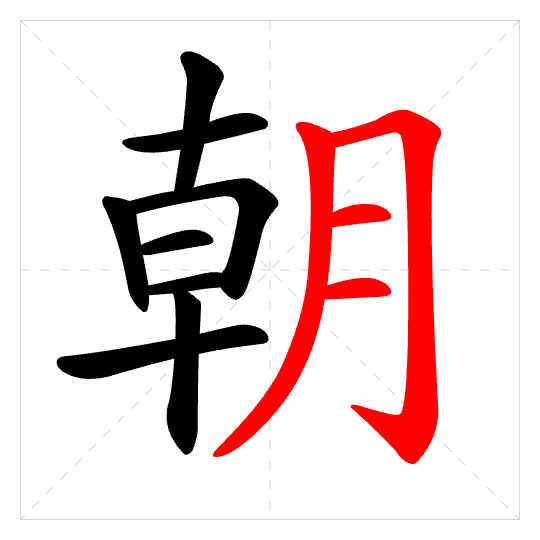
Basic Meaning
n
This sense is historical and formal. In modern political contexts, '朝野' can refer to 'the government and the public'.
(historical) imperial court; place where the emperor meets officials and issues orders. Also refers to the position of governing, opposite to 'the countryside'.
朝廷,帝王接见官吏、发号施令的地方。也指当政的地位,跟“野”相对。
Words:
在朝上朝在朝党朝野朝政
Synonyms:
廷
Antonyms:
野
Sentences:
- 朝野上下都在关注这件事。Both the government and the public are paying attention to this matter.
- 在朝的官员权力很大。Officials in the imperial court had great power.
n
Often paired with the name of the imperial family, e.g., '唐朝', '宋朝'. Can also refer to the general regime, as in '改朝换代'.
dynasty; the entire reign period passed down by generations of emperors of one surname.
朝代,某一姓的帝王世代相传的整个统治时期。
Words:
唐朝前朝改朝换代宋朝元朝
Synonyms:
Sentences:
- 唐朝是中国历史上一个非常繁荣的朝代。The Tang Dynasty was a very prosperous dynasty in Chinese history.
- 他的家族在前朝就已经很有名了。His family was already famous in the previous dynasty.
n
Used within a dynasty to refer to a specific emperor's reign, e.g., '康熙朝' means the period when Emperor Kangxi ruled.
period of a single emperor's rule.
指一个君主的统治时期。
Words:
三朝元老康熙朝光绪朝
Sentences:
- 他是一位历经康熙朝、雍正朝和乾隆朝的三朝元老。He was a senior official who served through the reigns of Kangxi, Yongzheng, and Qianlong.
v
The historical sense '朝见' is formal. The religious sense '朝圣' is still used for pilgrimages.
to go to court to meet the emperor; (for religious followers) to go to a holy site or temple to worship gods or Buddha.
臣子上朝进见皇帝;宗教徒到圣地、庙宇向神、佛礼拜。
Words:
朝见朝服朝圣朝觐朝顶
Synonyms:
谒
Sentences:
- 大臣们穿着朝服去朝见皇帝。The ministers wore court attire to meet the emperor.
- 每年都有很多信徒去拉萨朝圣。Every year many believers pilgrimage to Lhasa.
v
Often describes the orientation or direction of a fixed object, like a building or room. '四脚朝天' is a humorous idiom meaning falling flat.
to face; towards.
面对着;向。
Words:
朝向坐东朝西坐北朝南四脚朝天
Antonyms:
Sentences:
- 我们家房子的窗户都朝向大海。The windows of our house all face the sea.
- 他摔了个四脚朝天。He fell flat on his back.
prep
This is the modern, common usage. It introduces the direction of an action, similar to '向'. 朝(cháo2) + Direction, e.g., '朝前走'.
towards; facing (as a preposition).
表示动作的对象或方向。
Words:
朝前走
Sentences:
- 请朝左边走,出口就在那边。Please walk towards the left, the exit is there.
- 他朝我挥了挥手。He waved towards me.
Writing & Component
Radical月
Structureleft_right
Stroke Count12
Strokes一丨丨𠃍一一一丨丿𠃌一一