
所所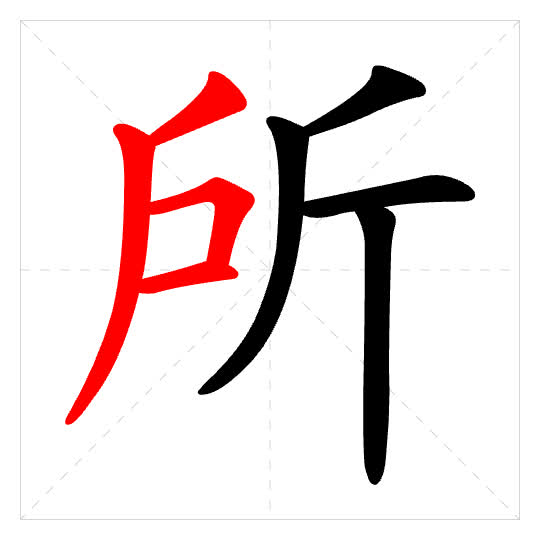
Basic Meaning
n
A formal or written term for a place or location. Often used in compound words like 住所 (residence) or 场所 (venue).
place; location
处所,地方。
Words:
住所各得其所哨所场所公所
Sentences:
- 这个公园是孩子们喜欢的游乐场所。This park is a playground that children like.
- 他在这个城市没有固定住所。He doesn't have a fixed residence in this city.
q
A measure word specifically for countable institutions like schools, hospitals, or residential complexes (e.g., apartments, villas). It is more formal and less common in daily spoken Chinese compared to 个 for general things.
measure word for institutions (e.g., schools, hospitals) and residential buildings
用于学校、医院等单位、住宅。
Words:
学校所医院所住宅所公寓所别墅所
Sentences:
- 这个区新建了一所医院。A new hospital was built in this district.
- 我们学校是全市最好的一所学校。Our school is the best school in the city.
part
Creates a noun phrase from a verb. For example, 所见 means 'what is seen'. This structure is common in written and formal Chinese. It can function as a subject, object, or modifier.
particle used before a verb to form a nominal phrase (equivalent to 'what' + verb or 'that which' + verb)
用在动词性词语前边,构成所字结构,相当于名词性词语,可做主语、宾语或名词修饰成分。
Words:
所见所闻所思所感所悟
Sentences:
- 他所说的都是事实。What he said is all true.
- 这是我今天所听到的最好消息。This is the best news I've heard today.
part
Used in passive constructions with 为 or 被. For example, 为生活所迫 means 'forced by life circumstances'. This is a formal structure.
particle used after '为' or '被' to indicate passive voice
放在动词前,跟前面“为”或“被”字相应,表示被动。
Words:
所迫所困所制所缚所累
Sentences:
- 他为形势所迫,不得不辞职。Forced by the situation, he had to resign.
- 她被他的真诚所感动。She was moved by his sincerity.
part
Used in structures like 所爱的 (the one who is loved). It emphasizes the object of the verb in a nominalized phrase. Common in written and formal contexts.
particle used before a '的' structure that acts as subject or object, indicating the object of the action
用在充当主语、宾语的“的”字结构前边,起着指示行为对象的作用。
Words:
所望所盼所爱所恨所欲
Sentences:
- 这不是我所希望的。This is not what I hoped for.
- 他所爱的只是她的钱。What he loves is only her money.
part
Similar to sense 7, but specifically when the phrase modifies a noun. For example, 所写的书 means 'the book that was written'. The noun (书) is the object of the verb (写).
particle used before a '的' structure that acts as an attribute, modifying a noun and indicating the noun is the recipient of the action
用在充当定语的“的”字结构前边,修饰后面的名词,表示名词是受事。
Words:
所书所画所写所织所制
Sentences:
- 这是他所画的最后一幅画。This is the last painting he painted.
- 我所写的书已经出版了。The book I wrote has been published.
Writing & Component
Radical户
Structureleft_right
Stroke Count8
Strokes丿丿𠃍一丿丿一丨