
尤尤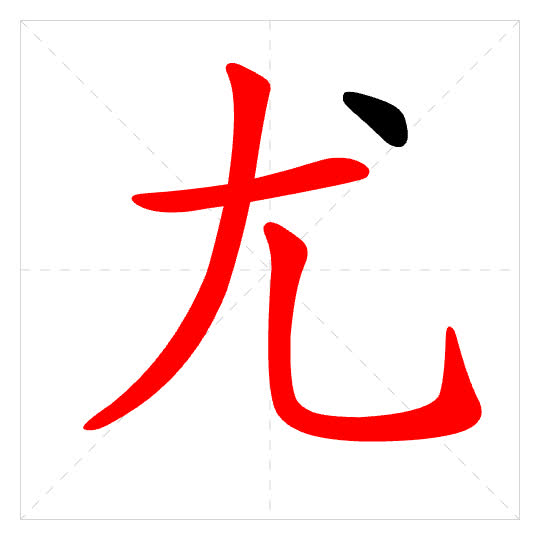
Basic Meaning
adj
This sense is typically used in set phrases. It's not commonly used as a standalone adjective in modern, everyday contexts.
special; outstanding
特异的;突出的。
Words:
尤物无耻之尤
Sentences:
- 他的数学才能尤为突出,经常能解决一些复杂的难题。His mathematical talent is particularly outstanding, and he is often able to solve some complex problems.
adv
The most common modern usage, equivalent to the adverb 'especially'. It's often used in formal or written contexts.
especially; particularly
尤其,更,格外。
Words:
尤甚尤妙
Sentences:
- 他对中国古代历史尤感兴趣。He is particularly interested in ancient Chinese history.
v
This sense is used exclusively in specific idioms or classical phrases, such as 怨天尤人.
to blame; to reproach
归咎;怨恨。
Words:
怨天尤人
Sentences:
- 面对失败,不应怨天尤人。When facing failure, one shouldn't blame heaven or reproach others.
Writing & Component
Radical尢
Structuresingle
Stroke Count4
Strokes一丿乚丶