
封封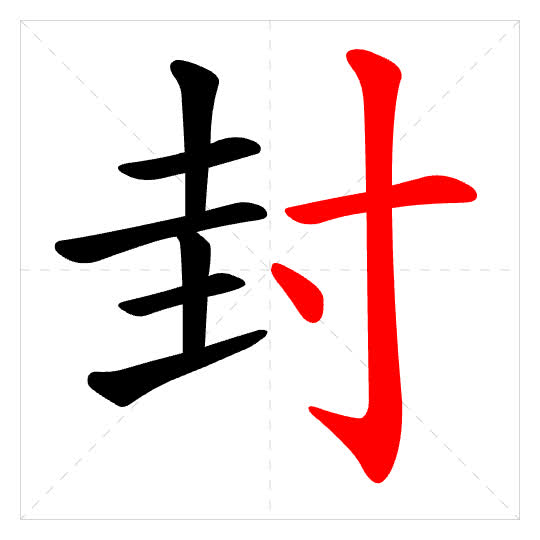
Basic Meaning
v
This sense is historical and used in classical contexts, often in historical stories or describing ancient practices. It appears in fixed phrases like 册封 and 封侯.
to confer (a title, territory, or noble rank) upon someone; to enfeoff.
古时帝王把爵位(有时连土地)或称号赐给臣子。
Words:
册封封侯封妻荫子分封诸侯封王
Sentences:
- 古代皇帝会分封诸侯,让他们管理不同的地区。In ancient times, emperors would enfeoff feudal lords, letting them govern different regions.
v
Commonly used for physical actions like sealing a letter (封信), sealing a door, or describing natural phenomena blocking a path (e.g., 大雪封山).
to seal; to close; to block off.
封闭;不许打开、动用。
Words:
封河密封大雪封山封关封山育林
Sentences:
- 冬天大雪封山,道路无法通行。In winter, heavy snow seals off the mountains, making the roads impassable.
- 他用胶带把盒子的开口封好了。He sealed the opening of the box with tape.
n
Refers to the physical container itself. The most common example is 信封 (letter envelope).
envelope; wrapper; a sealed packet.
封起来的或用来封东西的纸袋、纸包。
Words:
封套信封
Sentences:
- 请把这个文件放进封套里。Please put this document into the envelope folder.
- 他买了一个牛皮纸做的信封。He bought an envelope made of kraft paper.
q
A very common measure word. It's mostly used for letters (一封信) but can also be used for other packaged items presented as a unit (e.g., 一封银子).
measure word for things that are sealed or enclosed (like letters, packets).
用于封起来的东西。
Words:
一封信一封厚礼一封银子几封信
Sentences:
- 我昨天收到了一封朋友寄来的信。Yesterday I received a letter from a friend.
- 他送给我一封精致的贺卡。He gave me an exquisite greeting card (enclosed in an envelope/packet).
v
Often used in a figurative or negative sense, as in 故步自封 (to be stuck in old ways).
to confine; to limit.
限制。
Words:
故步自封
Sentences:
- 我们不能故步自封,要勇于尝试新方法。We cannot confine ourselves to old ways; we must be brave to try new methods.
v
Used in contexts of censorship or forbidding someone to speak, as in 封口令 (gag order).
to gag; to muzzle; to suppress (speech or opinions).
比喻压制言论。
Words:
封口令封嘴
Sentences:
- 公司高层下了封口令,禁止讨论这个项目。The company's top management issued a gag order, forbidding discussion of this project.
v
A highly specific, historical, and ceremonial term, found in classical texts and history. The key term is 封禅.
to perform a ritual sacrifice (by an emperor to heaven, earth, or mountains).
帝王筑坛祭天地及四方山岳之神。
Words:
封禅封祀
Sentences:
- 秦始皇曾到泰山举行封禅大典。Emperor Qin Shi Huang once went to Mount Tai to perform the grand Fengshan sacrifice ceremony.
v
A legal or administrative action, as in 查封店铺 (to seal up a shop).
to seal up (by legal authority); to confiscate.
查封。
Words:
查封
Sentences:
- 因为安全问题,这家工厂被查封了。Due to safety issues, this factory was sealed up by the authorities.
- 法院下令查封了他的银行账户。The court ordered the freezing (sealing up) of his bank account.
Writing & Component
Radical寸
Structureleft_right
Stroke Count9
Strokes一丨一一丨㇀一亅丶