
信信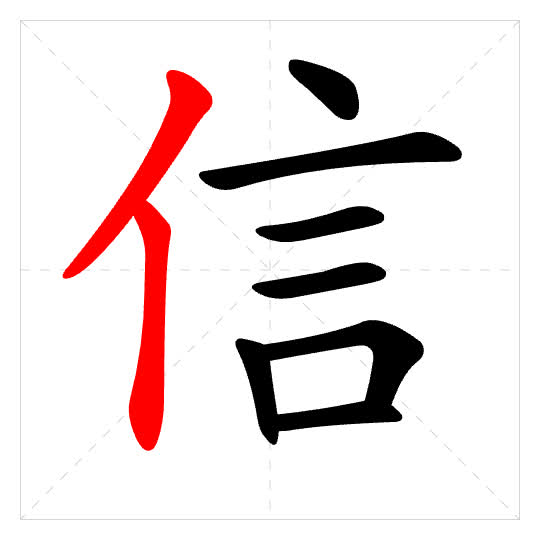
Basic Meaning
n
Often refers to physical or electronic mail. Common collocations include 写 (write), 送 (send), 收 (receive).
letter; written correspondence
按照习惯的格式把要说的话写下来给指定的对象看的东西;书信。
Words:
送信介绍信证明信写信书信
Sentences:
- 我昨天收到一封老朋友写的信。I received a letter written by an old friend yesterday.
- 你需要写一封介绍信才能申请这个职位。You need to write a letter of introduction to apply for this position.
n
Often used orally or informally, especially with '儿' suffix (信儿). Can be a simple verbal update.
message; information; news
(~儿)音信;消息。
Words:
Synonyms:
Sentences:
- 他让我给你带个口信儿,说他明天回来。He asked me to bring you a verbal message, saying he'll be back tomorrow.
- 自从他搬家后,我们就失去了音信。We lost contact (news) with him after he moved.
n
A specific, technical term. Mostly used in contexts like fireworks, explosives, or mines (e.g., 引信).
fuse; detonator
引信。
Words:
信管信线信药
Sentences:
- 在引爆之前,必须检查好信管。Before detonation, the fuse must be checked carefully.
adj
Describes information or history that is verified and credible (e.g., 信史). More formal/literary.
true; reliable; factual
确实;真实。
Words:
信而有征信史信而有据
Sentences:
- 这份历史记载有充分的证据,被认为是信史。This historical record has ample evidence and is considered reliable history.
adj
Describes a person's character regarding keeping promises. Often used in set phrases about trustworthiness (守信) or its lack (失信).
trustworthy; credible
信用。
Words:
言而有信守信失信信誉交关信用
Sentences:
- 他是一个守信的人,答应的事一定会做到。He is a trustworthy person; he will definitely do what he promises.
- 商业合作中,信用非常重要。Credit (trustworthiness) is very important in business cooperation.
v
The most common verb usage. Can be followed by a person, statement, or idea.
to believe; to trust
相信;信任。
Words:
Sentences:
- 我完全相信他说的话。I completely believe what he said.
- 你可以信任这位医生,他很有经验。You can trust this doctor; he is very experienced.
v
Specifically used for religious faith. Followed by the religion (e.g., 信佛).
to believe in; to be a follower of (a religion)
信奉(宗教)。
Words:
信教信徒信奉信佛信神
Sentences:
- 我的奶奶信佛,每天都会念经。My grandmother believes in Buddhism and chants sutras every day.
v
Almost always used in fixed, semi-idiomatic phrases (e.g., 信步, 信口开河). It indicates a casual, unrestrained action.
to act at will; to follow one's inclinations
听凭;随意;放任。
Words:
信步信口开河信口雌黄信马由缰信手拈来
Antonyms:
限束
Sentences:
- 傍晚时分,我喜欢在公园里信步走走。In the evening, I like to take a leisurely stroll in the park.
- 他经常信口开河,说的话不能全信。He often talks irresponsibly (shoots his mouth off); you can't believe everything he says.
n
An object or sign that serves as proof, authorization, or a pre-arranged sign. Common in historical or formal contexts.
token; credential; signal
符信;凭据。
Words:
Antonyms:
疑
Sentences:
- 在古代,印信是官员权力的重要象征。In ancient times, the official seal was an important symbol of an official's power.
- 这个戒指是我们的爱情信物。This ring is our token of love.
Writing & Component
Radical亻
Structureleft_right
Stroke Count9
Strokes丿丨丶一一一丨𠃍一