
不不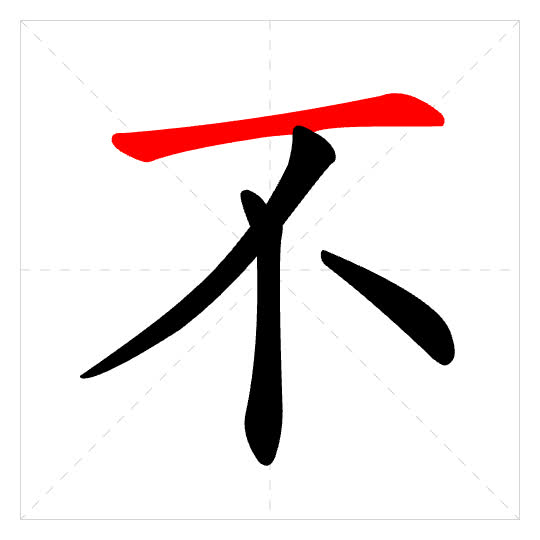
Basic Meaning
adv
common negation adverb
Used before verbs, adjectives, and other adverbs to indicate negation.
用在动词、形容词和其他副词前面表示否定。
Words:
不才不好不去不来不多
Sentences:
- 我不去那个地方。I am not going to that place.
- 这个苹果不好吃。This apple is not tasty.
adv
word-formation usage
Prefixed to nouns or nominal morphemes to form adjectives.
加在名词或名词性词素前面,构成形容词。
Words:
不法不规则不轨不甘不幸
Sentences:
- 这是一个不规则形状。This is an irregular shape.
adv
standalone response
Used alone as a negative answer (meaning opposite to the question).
单用,做否定性的回答(答话的意思跟问题相反)。
Sentences:
- A: 你喜欢这个电影吗? B: 不。A: Do you like this movie? B: No.
adv
complement structure
Used between a verb and its complement to indicate impossibility of achieving a result, opposite to 'de'.
用在动词和补语之间,表示不可能达到某种结果,用法上跟“得”相反。
Words:
拿不动说不明白跑不远还不来走不快
Sentences:
- 这个箱子太重了,我拿不动。This box is too heavy; I can't lift it.
- 他说得太快,我听不明白。He speaks too fast; I can't understand.
adv
interrogative particle
Used at the end of a sentence to indicate a question.
用在句末,表示疑问。
Words:
来不知道不去不想不睡不
Sentences:
- 你明天来不?Are you coming tomorrow?
- 你知道答案不?Do you know the answer?
adv
polite or formal usage
No need; don't (limited to certain polite expressions).
不用;不要(限用于某些客套话)。
Words:
不谢不客气
Sentences:
- 不客气,这是我应该做的。You're welcome; it's what I should do.
adv
choice structure
Used with 'jiu' to indicate a choice.
跟“就”搭配使用,表示选择。
Sentences:
- 你不去,我就自己去。If you don't go, I'll go by myself.
adv
reduplicative pattern
Used between two identical verbs, adjectives, or nouns to indicate indifference or irrelevance (often preceded by 'shenme').
用在相同的两个动词、形容词或名词中间,表示不在乎或不相干(前面常加“什么”)。
Words:
赔不赔难不难去不去管不管听不听
Sentences:
- 什么难不难的,试试看吧。What does it matter if it's difficult or not? Just give it a try.
- 管不管他,随你便。Whether you care about him or not is up to you.
Writing & Component
Radical一
Structuresingle
Stroke Count4
Strokes一丿丨丶